DSH rewind plugins: FileSnap vs dsh-rewind-plugin, deduplication and redo
Compare dsh-filesnap and dsh-rewind-plugin: seven storage cases show broader file-content reuse with FileSnap; examine redo, conversation behavior and file coverage.

Choosing a DeepSeek Harness rewind plugin starts with two questions: do you want to stay in the same conversation, and do you need to reverse the rewind itself? File coverage and recovery boundaries matter just as much as the command name.
中文版本 · FileSnap installation tutorial
Disclosure and method: we maintain dsh-filesnap, displayed as DSH Rewind & Redo — by FileSnap. Workflow documentation was reviewed on September 9, 2026; the FileSnap/SiriLee storage comparison was updated on September 10, 2026, with seven storage-component exercises. It is not a fresh DSH end-to-end test or a performance benchmark. The claims below describe these releases, not every future release or every DSH host version.
FileSnap’s documented advantages over SiriLee’s reviewed release are broader deduplication scope and /redo to reverse a rewind. Both plugins restore conversation and files and provide Web UI controls; the differences below explain when to choose each.
Choose by workflow
- Stay in the same conversation, with conversation-only rewind available: consider SiriLee’s
dsh-rewind-plugin. In the reviewed version,/undoopens rewind; it does not reverse a previous rewind. - Keep the original conversation and reverse a mistaken rewind: consider
dsh-filesnapand/redo. You continue in a child conversation sharing the same workspace, and uninstalling keeps conversation logs and workspace files, but captured sessions need the plugin reinstalled to reopen in DSH. - Use Git-based snapshots with recovery of the latest rewind: consider LJH-dot’s
dsh-rewindand/unrewind. Check its Git restore behavior and exclusion of untracked files first.
These recommendations follow the documented behavior of the releases below. The table and linked sources explain the tradeoffs; no overall winner is claimed from an unperformed hands-on test.
First, distinguish the packages
Two projects have a repository called dsh-rewind, but their npm packages differ.
| Project | npm package | Reviewed version |
|---|---|---|
| extracurricular-ai/dsh-filesnap | dsh-filesnap | 0.2.2 |
| SiriLee/dsh-rewind | dsh-rewind-plugin | 0.9.1 |
| LJH-dot/dsh-rewind | dsh-rewind | 0.11.12 |
The primary sources for the behavior table are each release’s documentation: FileSnap, SiriLee, and LJH-dot.
Compare the behavior you will notice
| Question | dsh-filesnap 0.2.2 | dsh-rewind-plugin 0.9.1 | dsh-rewind 0.11.12 |
|---|---|---|---|
| Where do I continue? | A child conversation; original retained | Same conversation, visible history rewound | Active conversation rewound; recovery data kept in a vault |
| Can I reverse the rewind? | /redo in the child | No built-in reversal documented; /undo is a rewind alias | /unrewind restores the latest rewind |
| Conversation-only mode? | Main rewind couples conversation and tracked files | Yes; picker also offers conversation + code | Yes; conversation/code flags available |
| How is the target selected? | Explicit displayed turn or point ID | Interactive rewind picker | Relative number; 1 means latest |
| Git required? | No | No | Uses Git snapshots; initializes a baseline when needed |
| What is the file boundary? | Known paths, observed filesystem writes, bounded recent scan | Registered write-tool paths and rescans of already tracked files | Git-based working-tree snapshots; untracked files excluded |
“Conversation and files together” and “no Git required” are shared capabilities of FileSnap and SiriLee’s plugin. They are not unique FileSnap claims.
File deduplication: where FileSnap reuses more content
dsh-filesnap is the DSH conversation-and-file rewind plugin; filesnap is its Rust storage engine. It is unrelated to the App Store app File Converter — FileSnap. The plugin integrates with DSH turns and provides a rewind control beside messages; users do not have to match timestamps in a standalone backup application.
Compared with SiriLee’s dsh-rewind-plugin 0.9.1, dsh-filesnap 0.2.2 with filesnap 0.4.0 has broader file-content reuse. The engine identifies complete file contents by SHA-256 and shares those blobs across paths, retained versions, sessions and workspaces using the same data directory. The competitor indexes the latest content by session and path, storing a reference when that content matches.
On September 10, 2026, we ran seven storage-component exercises using the released FileSnap CLI and the competitor’s shipped SnapshotStore. Each case used fresh stores and 64 KiB ASCII contents. These are content-copy counts, excluding metadata and filesystem allocation:
| Input pattern | FileSnap 0.4.0 | dsh-rewind-plugin 0.9.1 |
|---|---|---|
| Same path/session, A → A → A | 1 | 1 |
| Same path/session, A → B → A | 2 | 3 |
| Identical bytes at two paths | 1 | 2 |
| Identical bytes in two sessions | 1 | 2 |
| Identical bytes in two workspaces sharing the store | 1 | 2 |
| Three unique contents | 3 | 3 |
| Identical content after reopening the store | 1 | 1 |
Stored payload hashes and the competitor’s reference resolution were checked against input contents. Only the extracted module’s default-home resolver was adapted; tested stores always received explicit temporary paths. This is not both plugins running in DSH, a full restore test, or a capture-speed benchmark. The broader R01–R06 protocol remains unexecuted.
The advantage is broader reuse of identical content, not an established universal disk-space percentage. Both formats have metadata and retention policies. Content must still be retained to be reused, separate data directories do not share blobs, and whole-file hashing is not block-level or delta compression: changing one character in a large file can add a complete new blob.
Reproduction method and versioned source links · Raw results and hashes.
Integration experience across Codex, DSH and Pi
FileSnap’s snapshot design originated in our published codex-rewind distribution (codexr). The independent engine now powers the DSH integration dsh-filesnap and the Pi extension pi-better-rewind-redo. As of September 10, 2026, the DSH release is 0.2.2 with filesnap ^0.4.0; Pi’s release is 0.1.1 with filesnap 0.5.0; codex-rewind is 0.151.0-rewind.0 and retains its own related inlined snapshot module.
These releases provide concrete experience integrating conversation turns, file recovery and redo across coding assistants. Codex retains its inlined implementation, while DSH and Pi use different standalone engine versions; compatibility and validation scope are documented per project.
Public versions, source and validation scope.
When in-place rewind is the better fit
SiriLee’s plugin is a reasonable fit when you want to select an earlier message, stay in the same conversation, and optionally rewind only the conversation. Its visible-history change uses a marker in an append-only log. In-place does not mean the raw audit trail is erased.
Version 0.9.1 documents /undo as another way to open rewind. It does not document that command as undoing a previous rewind, and the README describes rewind as non-reversible through the built-in workflow. That is a property of this implementation; in-place designs can support recovery, as LJH-dot’s /unrewind illustrates. SiriLee README, LJH-dot README.
When a retained branch and redo are useful
Choose FileSnap when you want to keep the original conversation and have a direct way to reverse a mistaken rewind. A practical example is recovering a deleted file, realizing you chose a point too early, and using /redo before trying another point.
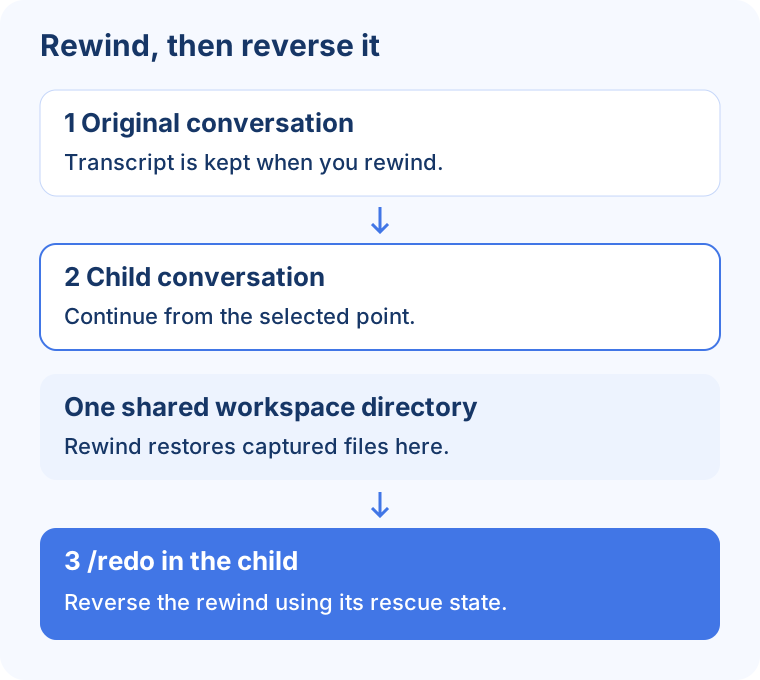
The cost is another conversation. The browser rewind action opens the child; the typed command returns a session to open. Also, both conversations use the same workspace directory. Preserving the original transcript does not preserve an independently editable copy of its files.
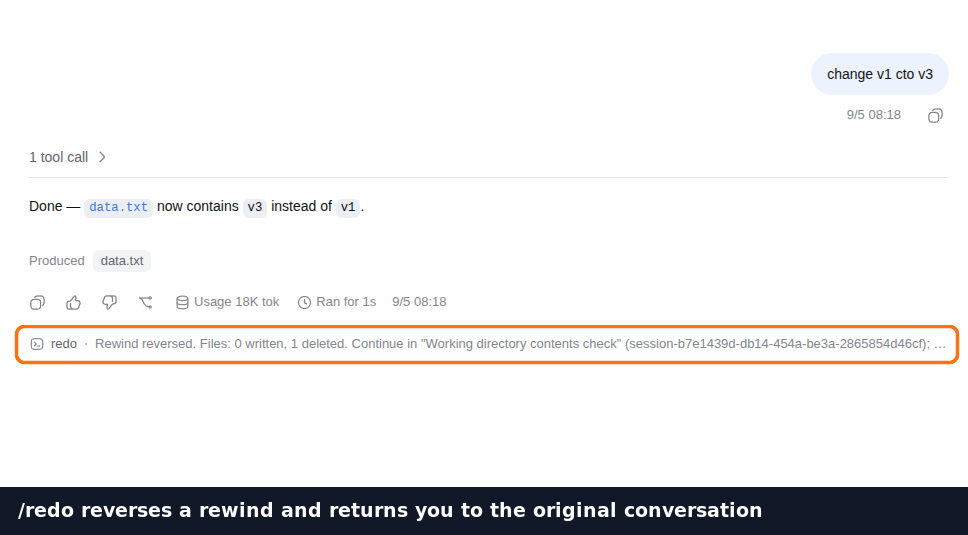
Uninstalling FileSnap 0.2.2 does not delete conversation logs or workspace files. Captured sessions need its event registration to open, so reinstall the plugin before reopening those sessions in DSH. Source startup via pnpm dsh can hit the same registration problem. There is no per-file restore picker in this release. These costs belong in the decision alongside redo. FileSnap documentation.
File coverage can decide the choice
SiriLee documents a boundary around files first seen through supported write tools. Rescans help with subsequent changes to registered files, but a first shell edit to an unregistered path is outside that mechanism. Its tracking-boundary documentation also explains snapshot timing limits.
FileSnap adds a bounded recent-change scan and can track observed filesystem writes outside the project root. That expands the intended coverage; it does not promise every shell-created file or an unlimited filesystem backup. Check /rewind status, .filesnapignore, and the target snapshot. Its architecture documentation describes these boundaries.
LJH-dot’s plugin uses Git operations for capture and restore. Its documented scope includes working-tree changes made outside DSH, while excluding untracked files. This may suit a Git-centered workflow, but it is a different recovery boundary from “all files on disk.” LJH-dot documentation.
Check compatibility and maintenance before adopting
SiriLee 0.9.1 includes instructions for users upgrading DSH to 0.1.3 and a repair path for older rewind markers. It also documents optional snapshot cleanup. Read the release’s upgrade instructions and cleanup guide. A host upgrade is a reason to recheck behavior, not to reuse an older audit verdict.
For SiriLee and LJH-dot, this review does not establish every uninstall or host-upgrade outcome. Verify those paths in a disposable session before relying on them. For all three, record the plugin version and host version, then test the files your workflow actually changes—including untracked files, binary assets, and shell edits if you use them. Binary round-trip behavior was not independently exercised for this article.
If FileSnap matches your workflow, the illustrated tutorial covers installation, explicit target selection, the child conversation, and /redo.